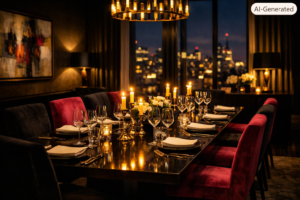

To host an executive dinner, set one clear objective, invite around ten senior peers who share a real problem, and book a private room where they can hear each other. Frame the evening around one question, chair it lightly under the Chatham House Rule, keep any sponsor as host rather than presenter, and follow up personally.
That is the short version. This guide walks through each step in the order you will meet them, for anyone planning a dinner for senior leaders, whether you are hosting CFOs or CIOs for the first time or weighing up the format as a sponsor.
If you’d rather hand the whole evening to specialists, see how our team runs executive dinners for B2B hosts.
First, what counts as an executive dinner
An executive dinner is a small, invitation-only dinner for senior leaders, held in a private room, built around a conversation rather than a presentation. The guest list is curated for seniority and relevance. There is no pitch, no stage and no lanyards.

It helps to be clear about what it is not. It is not a networking event, so there is no mingling session or speed-networking round. It is not a roundtable, which is usually more agenda-driven and may include external speakers. And it is not a restaurant review: the venue matters, but it serves the conversation rather than being the point of the evening.
If you want the full definition, history and variations of the format, read our guide What Is an Executive Dinner? This post focuses on how to host one well.
Step 1: Start with the objective
Before you think about venues, menus or guest lists, decide why the dinner exists. Senior leaders do not give up an evening for generic networking. They come when the topic speaks directly to their responsibilities, pressures and priorities.
Answer three questions before anything else:
- What should guests leave knowing, understanding or considering?
- What challenge or opportunity will the dinner help them explore?
- How does the evening support your wider engagement plan?
The answers become the anchor for every later decision, from who you invite to how the conversation is framed. When the purpose is clear, the dinner feels worth a senior person’s time. When it is not, it becomes another unfocused corporate meal.
Is a dinner the right tool at all?
Be honest here. The format works when your audience genuinely values peer conversation, when you have something real to contribute to that conversation, and when your sales cycle is long enough for a relationship to matter. If you need to close in two weeks, a dinner is too slow. If you need hundreds of leads, a dinner is too small. If you want to build trust with a dozen senior buyers your sales team cannot reach by phone, it is one of the most efficient things you can do.
Step 2: Define the audience and build the guest list
The guest list is everything. The strength of an executive dinner comes from the alignment of the people around the table, not from the number of titles on the seating plan.

Curate for relevance between guests, not only for seniority. A table of technology leaders who share no common problem will produce small talk. A table of technology leaders all working through the same infrastructure change will produce a conversation nobody wants to leave. Guests should hold similar levels of responsibility, face comparable challenges and understand the context of the discussion.
Build the list from the profile you agreed in Step 1: sector, seniority, the kind of organisation, and the problem you want them to discuss. Then vet every name against it. Senior leaders want to be chosen for their perspective, not targeted for their budget, and they can tell the difference.
Hosting a CFO, CIO or CISO dinner
The principles are the same for every function, but the question changes. A finance table wants to talk about the decisions finance leaders are wrestling with now. A technology table wants the same for its own world. Choose a topic the whole table owns, and keep functions together unless mixing them is the point of the evening. For sector-specific formats, see our pages for CFOs and finance leaders, CIOs and CTOs, CISOs and security leaders, procurement leaders and marketing leaders.
Step 3: Choose the format and table size
The ideal group is typically 8 to 12 guests. Our own private executive dinners are built around ten seats and one question. That size allows balanced contribution and a single, shared conversation. Go much larger and the table splits into side conversations. Resist the urge to overfill it: more people rarely means more value.

Keep the format simple. One table, one conversation, one chair. No slides, no panel, no scheduled one-to-one slots. If your goal needs a more structured, agenda-led session with speakers, you may want a roundtable instead. Our comparison of executive roundtables and executive dinners sets out the difference.
Step 4: Pick a venue that serves the conversation
Senior leaders open up in settings that feel calm, private and deliberate. Choose a venue that supports conversation rather than one that overwhelms it. When you assess a room, check:

- Privacy. A private dining room, not a corner of a busy restaurant or a hotel function suite.
- Acoustics. Low noise, so every guest can hear every other guest without raising their voice.
- Table shape. A layout that allows eye contact across the table and one conversation, not three.
- Lighting. Soft enough to feel relaxed, bright enough to see faces.
- Service. Discreet staff and a pace of service that does not interrupt the discussion.
- Location. Central and easy to reach after a working day.
If you are hosting in London, our London venues guide lists rooms we consider suited to senior conversation. Three examples: Searcys Horizon 22, on the 58th floor of 22 Bishopsgate in the City; Haymarket Hotel, a design-led hotel in St James’s with private spaces for executive dinners; and Covent Garden Hotel on Monmouth Street, a quieter option for discreet conversations.
Step 5: Send invitations and secure confirmations
Invitations should be discreet, personal and purposeful. A senior leader deciding whether to give up an evening wants to know four things quickly:
- The question the table will discuss, and why it matters to them now.
- Who else will be there, described by role and sector rather than by name.
- How the evening works, including that it is off the record and that nobody will be sold to.
- Who is hosting, and why.
Once someone accepts, reconfirm as the date approaches, share practical details in good time, and keep a short reserve list so a late withdrawal does not leave a gap in the table. Plan the same way for anyone the evening depends on, including your chair. It is one of the most common ways an event fails: a last-minute technical problem or diary change can leave a session without its only speaker, so always line up a backup and test any virtual set-up on the day.
Step 6: Design the conversation and set the ground rules
A good executive dinner is neither a free-for-all chat nor a presentation. It sits in the middle: structured enough to stay on topic, relaxed enough to feel natural.
Anchor the evening around one central question and two or three themes that sit underneath it. Prepare a few structured opening questions so the conversation starts with substance rather than introductions. Plan the seating so that colleagues and natural allies are split up, which gives every guest a reason to talk to someone new.
The role of the chair
A strong chair is essential. Their job is to guide the flow, balance contributions and keep the discussion tied to the purpose. They should be present but not dominant. A poorly chaired dinner turns into one person holding the floor while everyone else checks their phone. A well-chaired one draws in the quieter guests, moves on from a point that has run its course, and knows when to stay silent. When it is done well, the structure is invisible.
The Chatham House Rule
We run our dinners under the Chatham House Rule: guests may use what they hear, but may not reveal who said it or who else was present. State the rule in the invitation, repeat it at the start of the evening, and honour it in everything that follows, including any written summary. Senior leaders speak candidly only when they trust that what they say will not be attributed to them.
Step 7: Run the night
The best dinners follow a simple rhythm:

- Arrival and informal welcome. A short, relaxed start while guests arrive. Greet each person by name and introduce them to someone before they have a chance to reach for their phone.
- Opening context from the host. A brief welcome: why this group, why this question, and a reminder of the Chatham House Rule. Minutes, not a speech.
- The guided conversation. The chair opens the first theme and moves through the others as the evening develops, with service paced around the discussion rather than the other way round.
- A clear close. Thank guests, reflect back what the table covered, and say what happens next, whether that is a summary, a future dinner or a private conversation.
Behind the scenes, someone other than the host should own the logistics on the night: venue liaison, timing, late arrivals and anything that goes wrong. The host’s attention belongs at the table.
The sponsor’s role: host the conversation, never pitch it
Many executive dinners are funded by a sponsor who wants time with a particular senior audience. This is where dinners succeed or fail.
If the sponsoring company treats the dinner as a product demo by other means, guests feel it immediately and the trust is gone. If it treats the evening as a genuine peer gathering, with its own senior person at the table as a participant rather than a presenter, trust builds in a way no follow-up email can create.
In practice, a sponsor should:
- Choose a topic its buyers care about, not a topic about its product.
- Send a senior person who can contribute to the conversation as a peer.
- Leave the slides, brochures and demos at the office.
- Let the chair run the table, and speak as often as any other guest, not more.
The payoff is that follow-up rarely needs to explain what the company does. The dinner has already done that without a single slide. If you are considering sponsoring a dinner, our sponsor page explains how we agree the audience with you, curate and confirm the table, and handle the venue, table composition, pacing and flow while your brand hosts.
Step 8: Follow up with care
The dinner is the start of a relationship, not the end of an event. Close the loop well:
- Thank each guest personally. A short, specific note that references the conversation, not a template.
- Share a summary of themes, if you promised one. Keep it to anonymised themes so it respects the Chatham House Rule. Our sponsors receive a concise insights report covering the themes, sentiment and opportunities raised.
- Offer the next step, not a sales sequence. A future dinner, an introduction to another guest, or a private conversation if a guest has asked for one.
- Review the evening internally. What worked, who contributed most, what you would change about the question, the room or the guest mix next time.
Common mistakes to avoid
- No clear purpose. A dinner “to build relationships” with no question at its centre drifts into small talk.
- Curating for titles, not relevance. Senior guests with nothing in common will be polite and leave early.
- Overfilling the table. Beyond about a dozen guests, one conversation becomes several.
- Pitching. A product presentation over dessert undoes everything the evening built.
- A chair who dominates, or no chair at all. Both leave the conversation to whoever talks loudest.
- Breaking confidentiality. Quoting a guest by name afterwards, even in praise, costs you the room next time.
- No backup plan. Any single person the evening depends on needs a stand-in.
- Weak or generic follow-up. A templated sales email the next morning tells guests what the dinner was really for.
Executive dinner planning checklist
- Objective written down in one or two sentences
- Honest check that a dinner is the right format for the goal
- Guest profile agreed: sector, seniority, organisation type and shared problem
- Guest list curated and vetted against that profile, with a short reserve list
- Table size set at 8 to 12
- Private room booked and checked for acoustics, layout, lighting and service
- Personal invitations sent, stating the question, the format and the no-pitch rule
- Confirmations received and reconfirmed closer to the date
- Central question, two or three themes and opening questions prepared
- Seating plan drawn up to split colleagues and natural allies
- Chair briefed, with a backup identified
- Chatham House Rule included in the invitation and the opening remarks
- Sponsor briefed on its role as host, not presenter
- Run of show shared with the venue and the team
- Personal thank-you notes and any anonymised summary ready to send
- Internal review booked
Frequently asked questions
How many guests should an executive dinner have?
Usually 8 to 12. That is small enough for one shared conversation and large enough for a range of views. Our own executive dinners are built around ten seats.
Do executive dinners run under the Chatham House Rule?
Ours do. Guests can use what they hear but cannot attribute it to anyone or say who was present. It is what allows senior leaders to speak candidly, so state it in the invitation and repeat it at the start of the evening.
Can a sponsor pitch at an executive dinner?
No. The sponsor hosts the conversation and its senior person takes part as a peer. The moment a dinner becomes a pitch, guests stop talking openly and the value is lost.
What is the difference between an executive dinner and a roundtable?
A dinner is one relaxed conversation over a meal in a private room, guided by a chair. A roundtable is usually more structured and agenda-driven, and may include external speakers.
What should happen after an executive dinner?
Thank each guest personally, share any promised summary as anonymised themes, and offer a sensible next step such as a future dinner or a private conversation. Avoid moving guests straight into a sales sequence.
Is an executive dinner right for every company?
No. It suits organisations with a long sales cycle, a senior audience that values peer conversation, and something real to contribute. If you need a large volume of leads quickly, another format will serve you better.
Plan your dinner with us
Before establishing Convene X Events, our founding team spent several years designing and delivering senior-level events and executive programmes for large enterprise organisations. We now run invitation-only executive dinners in London for senior leaders in finance, cybersecurity, IT, procurement and marketing.
If you are planning a dinner, or considering sponsoring one, tell us the audience and the question that matters and we will help you shape the rest. Book a call with our team.