Shopping Cart
CloseNo products in the basket.
Filter
close
10 Best Private Dining Rooms in Mayfair for High-Value Executive Dinners
Hosting C-suite executives requires a delicate balance: the space must project prestige without feeling overly ostentatious, and the atmosphere must be private enough to foster candid, high-stakes conversation. In the realm of UK enterprise field marketing, Mayfair remains the gold standard for hosting high-value B2B dinners.
The B2B Lead Gen Guide: 10 Best Private Dining Rooms in Mayfair for High-Value Executive Dinners
Elevating the Corporate Roundtable: Why the Right London Space Secures the C-Suite
Securing the undivided attention of C-suite decision-makers is one of the steepest challenges in modern B2B marketing. When traditional digital channels are saturated with high-friction ad campaigns and impersonal automated emails, the most successful enterprise brands pivot to a highly tactile, offline strategy: the intimate, invite-only corporate dinner.
However, getting a busy executive to commit their personal evening to your brand requires an immediate signal of prestige and exclusivity. The choice of venue is not merely a logistical detail; it is the physical manifestation of your brand’s value proposition.
To help you capture maximum interest, we have curated ten of London’s most exclusive private dining spaces—combining design-led boutique luxury with world-class culinary institutions across Mayfair, Soho, Fitzrovia, and Covent Garden.
Elite Private Dining Venues in London
From Michelin Stars to Boutique Design: London's Premier Spaces for Closed-Door Networking
HIDE – The Hide & Seek Room (Mayfair)
Capacity, Atmosphere, and Privacy
Capacity: Up to 24 guests seated (or split into two smaller rooms of 12).
Atmosphere: Striking, wood-crafted modernism overlooking Green Park with bespoke menus curated by Michelin-starred culinary teams.
Privacy: Complete subterranean seclusion, allowing for highly sensitive B2B discussions away from public dining areas.
The Soho Hotel – Indigo Room (Soho)
Capacity, Atmosphere, and Privacy
Capacity: Up to 24 people for a boardroom table, or 50 people for elegant private dining.
Atmosphere: Bold, vibrant, and effortlessly stylish—designed by Kit Kemp with striking contemporary British art.
Privacy: A completely self-contained, flexible private space that offers a relaxed yet incredibly polished environment for tech and creative sectors.
Pavyllon London – Pavyllon Privé (Mayfair)
Capacity, Atmosphere, and Privacy
Capacity: 8 to 40 guests seated.
Atmosphere: Elegant, modern French luxury flooded with natural light, nestled within the prestigious Four Seasons Park Lane.
Privacy: Highly discreet and quietly secluded from the main hotel foot traffic, keeping your guests focused on the conversation.
The C-Suite Reality Check Networking is about volume. Executive dinners are about relevance. Senior leaders don’t need more conversations — they need the right ones. This isn't a social hour. When you gather ten C-suite executives in a room, you are facilitating a strategic, high-trust environment where real operational decisions happen. Stop relying on one-to-many presentations. Build your enterprise pipeline through curated, intimate, and outcome-driven dialogue.
Convene X Team Book a call with events team
Charlotte Street Hotel – Vanessa Bell Room (Fitzrovia)
Capacity, Atmosphere, and Privacy
Capacity: Up to 24 people for a boardroom table, or 32 people for private dining.
Atmosphere: Brimming with character, featuring rich textures, Bloomsbury Group-inspired design, and warm, sophisticated lighting.
Privacy: Completely private ground-floor room, ideal for hosting intimate industry roundtables in the heart of London’s media and agency hub.
Corrigan’s Mayfair – The Lindsay Room (Mayfair)
Capacity, Atmosphere, and Privacy
Capacity: Up to 24 guests seated.
Atmosphere: Classic, club-like British luxury featuring deep blue leather, rich wood paneling, and Richard Corrigan’s renowned culinary heritage.
Privacy: Fully sound-insulated walls offering absolute acoustic discretion for high-level boardroom discussions.
The Wolseley – The Private Dining Room (Mayfair)
Capacity, Atmosphere, and Privacy
Capacity: Up to 14 guests seated.
Atmosphere: Timeless European grand-café styling with majestic arched windows overlooking Piccadilly.
Privacy: Elevated quietly above the main dining room, offering a dramatic bird’s-eye view of the venue while remaining acoustically private.
Charlotte Street Hotel – Dora Carrington Room (Fitzrovia)
Capacity, Atmosphere, and Privacy
Capacity: Strictly intimate, seating up to 10 guests.
Atmosphere: Light-filled with double doors opening onto Charlotte Street, featuring bold fabric walls and a stunning hand-painted mural.
Privacy: Perfect for ultra-exclusive, closed-door dinners with your most valuable tier-one accounts.
Park Chinois – Salon Rouge (Mayfair)
Capacity, Atmosphere, and Privacy
Capacity: Up to 12 guests seated.
Atmosphere: A breathtaking, decadent cocoon of red silk, gold accents, and a lavish 1930s Shanghai aesthetic.
Privacy: Absolute visual and acoustic isolation, creating a highly memorable sensory escape for senior leadership.
Covent Garden Hotel – Lyric Room (Covent Garden)
Capacity, Atmosphere, and Privacy
Capacity: Up to 20 guests for private dining.
Atmosphere: Richly decorated with theatrical flair, colourful textiles, and comfortable, premium seating.
Privacy: Intimate and entirely self-contained, offering a relaxed but undeniably upscale backdrop for evening networking.
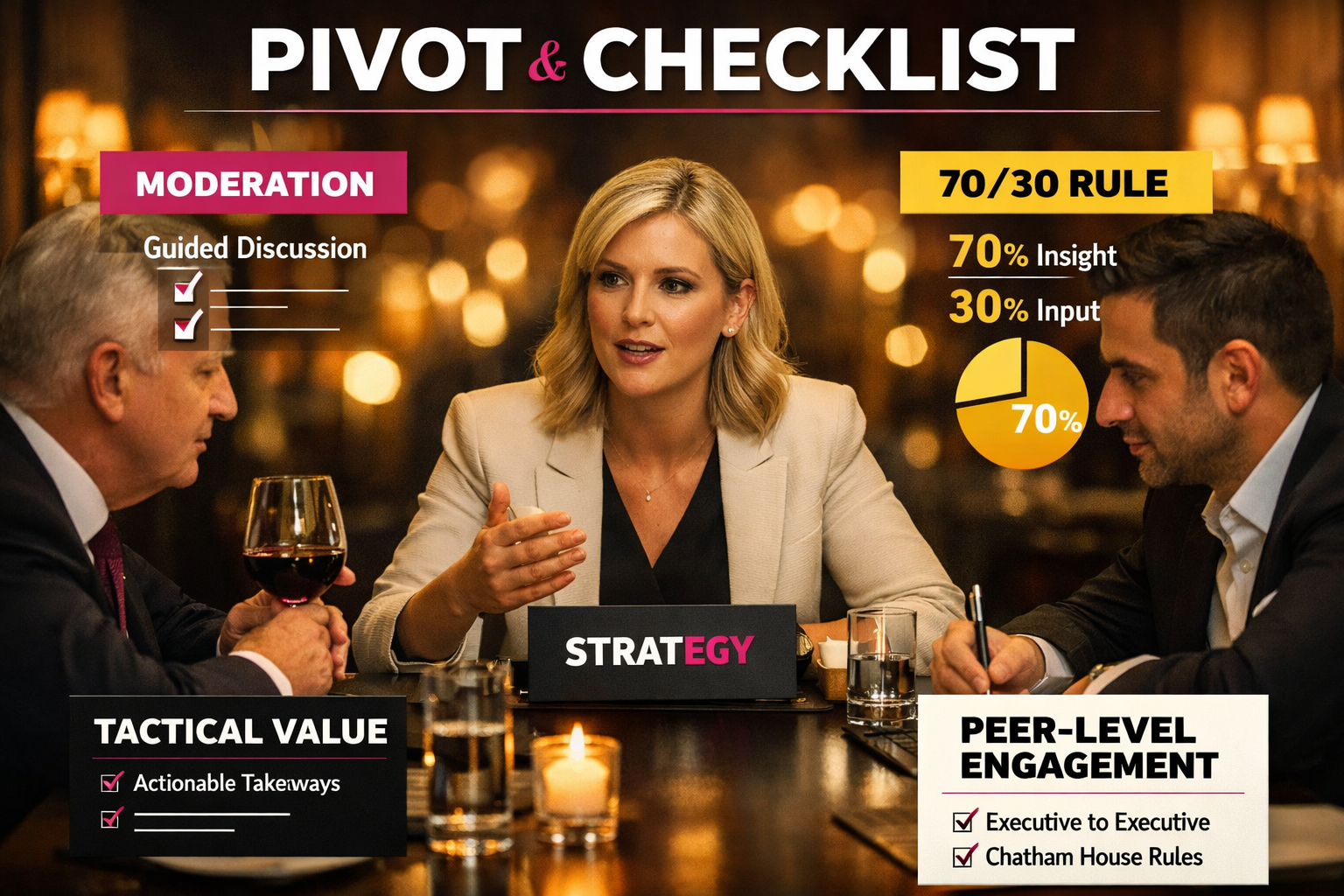
The Strategic Shift: From Logistics to Pipeline Generation
Integrating Virtual Roundtables and Private Dinners (The Connected Pipeline)
Securing a premium room in London gets them to say yes to the invitation. But how do you ensure that dinner actually converts into closed B2B pipeline? That’s where executive event strategy comes in.
Too many brands spend 90% of their budget securing a stunning room, only to run the evening like a glorified sales presentation. The moment an executive sits down and sees a slide deck or a heavy-handed product pitch, they mentally disengage.
To yield a real return on your event spend, you must treat the dinner as a curated, peer-to-peer think tank.
The C-Suite Execution Checklist
Integrating Virtual Roundtables and Private Dinners (The Connected Pipeline)
To transition a premium London dinner from a luxury social gathering into a high-performance engine for your late-stage sales pipeline, you must execute a flawless operational framework.
When dealing with C-suite executives, the margin for error is non-existent. A poorly structured evening will not only fail to convert pipeline; it can actively damage your brand’s reputation among key accounts. Implement this precise three-pillar operational structure to establish trust, unlock authentic dialogue, and accelerate complex enterprise sales cycles.
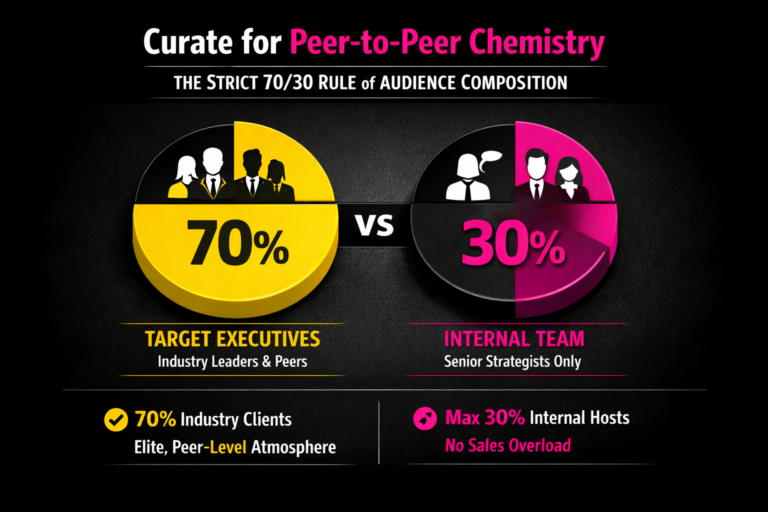
Curate for Peer-to-Peer Chemistry
The Strict 70/30 Rule of Audience Composition
The most common mistake in B2B event hosting is flooding the room with eager sales representatives. The moment an executive walks into a private room and realizes they are outnumbered by your account executives, they will instantly raise their defensive walls.
To maintain an elite, peer-to-peer atmosphere, you must strictly enforce a 70/30 ratio: 70% of the room must consist of qualified, external industry peers (your target clients), while no more than 30% should be represented by your internal hosting team.
Furthermore, your internal attendees must match the seniority of your guests. If you are hosting Chief Information Officers (CIOs), your internal representatives should be your CTO, CEO, or high-level strategic directors—not mid-level sales managers. Executives want to converse with peers who share their strategic horizon, not individuals incentivized to close a transaction by the end of the quarter.
Mitigating Market Friction in Guest List Selection
Siloing Competitors to Protect Confidentiality
While you want to assemble a room of influential minds, you must strategically curate the guest list to avoid market-share friction. Placing direct, fierce competitors next to one another at a single table is a guaranteed way to kill conversation.
If a Chief Security Officer (CSO) from one major bank is seated directly opposite their primary competitor, both individuals will naturally withhold their genuine challenges, operational pain points, and strategic plans to protect trade secrets.
Before finalized invitations are sent, map out the relationships between your target accounts. If you must invite competing firms, host them at entirely separate events or ensure they are placed at different ends of a multi-table setup. Your goal is to curate a highly collaborative, non-threatening ecosystem where peers feel entirely safe discussing their true operational roadblocks.
Establish “Chatham House Rules”
Fostering Psychological Safety from the First Pour
High-value B2B decision-makers operate in high-pressure, heavily scrutinized environments. To get them to speak candidly about what is actually broken in their organizations, you must establish an environment of absolute psychological safety.
At the very beginning of the evening—ideally during the welcoming remarks before the first course is served—the host must explicitly declare that the evening is governed under the Chatham House Rule:
“Under the Chatham House Rule, participants are free to use the information received, but neither the identity nor the affiliation of the speaker(s), nor that of any other participant, may be revealed.”
This simple, formal declaration instantly lowers the guard of your guests. It shifts the dynamic of the room from a cautious public-relations exercise to a confidential, closed-door advisory board. When executives know their comments won’t leave the room or be used against them in a competitor’s marketing materials, they open up about their real systemic challenges.
Focusing the Agenda on Macro-Industry Challenges
Your product, software, or platform should not be mentioned during the formal dinner discussion. The moment you introduce a feature list, a slide deck, or a product pitch, the intellectual value of the evening evaporates, and the event is demoted to a sales pitch.
Instead, center the entire evening’s agenda around a complex, macro-level industry challenge that your target accounts are actively trying to solve. For example, rather than framing a dinner around “Optimizing Cloud Database Efficiency with Our Software,” frame it as:
“Navigating the Transition to AI-Driven Infrastructure: Balancing Enterprise Security with Rapid Innovation.”
By focusing on high-level strategic obstacles, you elevate the conversation. This allows your target clients to share their struggles, debate methodologies, and offer peer-to-peer advice.
By observing this discussion, your team gains priceless, unvarnished insight into each target account’s specific pain points—giving your sales team the exact context they need to follow up with highly tailored, relevant solutions post-event.
Deploy a Trained, Neutral Moderator
Maintaining Table Balance and Preventing Conversational Dominance
A luxury private dining room can quickly become chaotic without structured leadership. Every group of high-profile executives will naturally have dominant personalities who seek to monopolize the airtime, as well as highly brilliant, introverted leaders who prefer to observe.
A trained, neutral moderator is essential to balance this dynamic. The moderator’s role is not to lecture, but to act as a master facilitator. They must actively guide the conversational flow, ensuring that dominant guests are politely managed, and quieter, high-value decision-makers are seamlessly drawn into the dialogue.
A skilled moderator will use gentle, probing prompts like:
“That is an incredibly unique perspective on cloud migration, Sarah. David, I know your team recently underwent a similar transformation in the retail sector—how does that align with what you experienced?”
This level of active moderation keeps the table highly engaged, dynamic, and intellectually stimulating for everyone in attendance.
Smoothly Guiding the Narrative Back to Strategic Value
While the moderator must remain completely neutral and avoid making any direct sales pitches, they must also possess a deep, sophisticated understanding of your business’s core value proposition.
As the dinner progresses, the moderator’s objective is to subtly synthesize the collective pain points discussed at the table and connect them back to the macro-level strategic frameworks your company specializes in.
When the table consensus inevitably turns to a shared hurdle—such as data compliance or legacy integration—the moderator should seamlessly weave in high-level insights:
“It sounds like the consensus around the table is that compliance isn’t just a regulatory checkbox anymore, but a core bottleneck to deployment speed. What we often see when working with global enterprises is that decoupling the security layer early in the architecture phase solves this exact friction…”
This positions your hosting brand not as a pushy vendor, but as an enlightened, authoritative thought leader that deeply understands their world. You build immense commercial trust, paving the way for your sales team to easily secure follow-up discovery calls in the days following the dinner.